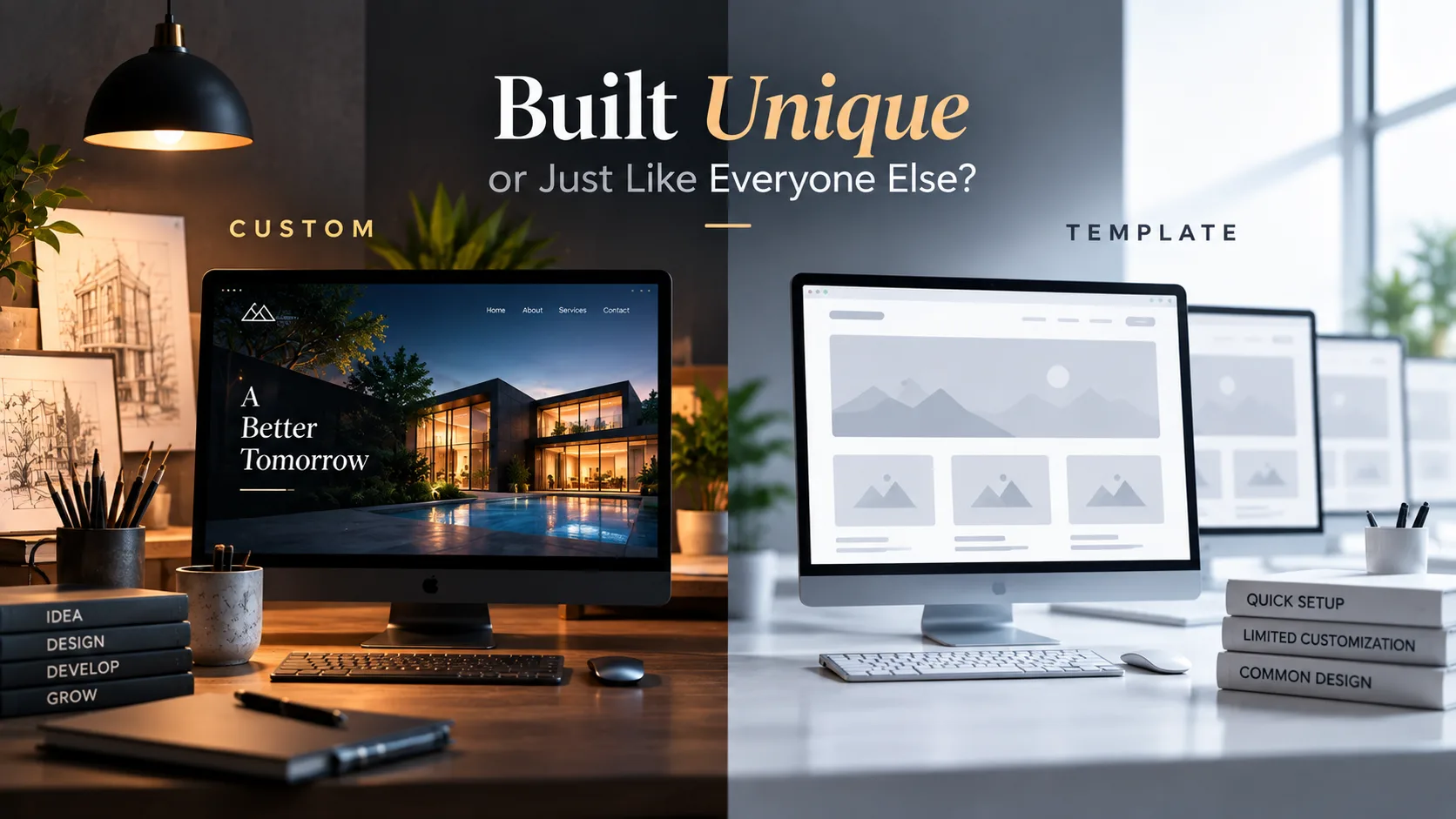
Custom vs Template Websites in 2026: Which Is Better Choice?
A website is often the first place people judge your brand. In 2026, that first look matters more than ever. Users expect speed, trust and a clean mobile view. Search systems also reward useful pages and strong page experience. Google’s guidance still points site owners toward helpful content, good Core Web Vitals and mobile first readiness.
Building a site in 2026 demands a major choice. That is why the choice between Custom websites and Template websites deserves care. One gives full freedom. The other gives speed and low cost. The right pick depends on your goals, budget and growth plan.
A strong site builds deep trust with buyers. It acts as your primary digital storefront. It drives your daily sales. We will explore both options clearly. This guide helps you pick the right path.
1. What Is a Custom Website?
A custom website is built from the ground up for one brand. It does not depend on a fixed theme or a readymade layout. Every page, feature and flow is shaped around your business.
This route suits brands that need:
- a distinct identity
- better control over speed and structure
- advanced features
- room to scale over time
For serious growth, Custom websites give more room to build without limits. They also make it easier to match the site to your brand voice and your sales process.
Developers build a custom site just for you. They do not use pre made, rigid designs. Every single detail fits your exact goals.
- Fully tailored design and functionality: You get a truly unique brand look. The features match your specific workflow needs.
- Built from scratch: Developers write the structure using HTML, CSS and JavaScript. They also utilize advanced technologies like Python, React and Node.js.
- Ideal use cases: These sites fit large business platforms perfectly. E commerce stores and complex web apps need them. Custom web development gives you total creative control.
2. What Is a Template Based Website?
A template site uses a readymade design. You pick a theme and install it. Then, you simply add your text and images.
- Pre designed layouts and themes: The visual structure already exists. You only need to replace the dummy sections.
- Popular platforms: People widely use WordPress, Wix and Shopify. These are the top CMS platforms right now.
- Ideal uses: These work best for small businesses. New businesses and rapid product rollouts often prefer this speedy approach.
Template sites are often best for:
- small businesses
- start-ups
- test launches
- simple service sites
- early stage ecommerce stores
3. Key Differences between Custom and Template Websites
3.1 Design Flexibility
|
Factor |
Custom Website |
Template Website |
|---|---|---|
|
Design uniqueness |
100% unique |
Shared with thousands of others |
|
Branding control |
Full control |
Limited by theme structure |
|
Layout freedom |
Unlimited |
Restricted to theme grids |
|
Custom animations |
Yes |
Limited or plugin dependent |
Custom websites give you a blank canvas. You design every pixel around your brand.
Template websites are quick to build, but they come with limited design flexibility. Many businesses end up looking similar because they use the same popular themes.
3.2 Cost Comparison
|
Type |
Initial Cost (Approx.) |
Monthly Maintenance |
|---|---|---|
|
Custom Website |
₹1,50,000 – ₹10,00,000+ |
₹5,000 – ₹30,000+ |
|
Template Website |
₹0 – ₹30,000 |
₹500 – ₹5,000 |
Custom websites require a higher upfront investment. But this is a long term asset. You own everything. You won’t have ongoing platform charges or plugin license expenses reducing your budget.
Template websites cost much less to start. But hidden costs add up. Premium themes, paid plugins, hosting upgrades and developer fees for workarounds can surprise you over time.
3.3 Development Time
|
Type |
Typical Timeframe |
|---|---|
|
Custom Website |
6 weeks – 6 months |
|
Template Website |
1 day – 4 weeks |
Custom websites take longer. That's the honest truth. Design, development, testing and iteration all take time.
Template websites let you go live fast. If launching quickly is more important than having a unique design, templates are the better choice in this case.
3.4 Performance and Speed
Page load speed and Core Web Vitals are now critical ranking factors on Google.
- Custom websites are lean by design. The website contains only the necessary code required for functionality. Result: faster load times, better user experience (UX) and higher search rankings.
- Template websites often come packed with bloated code. Many themes load scripts you never use. This slows your site down and hurts your rankings.
3.5 SEO Capabilities
Custom websites are developed with search engine optimisation in mind. Every tag, every URL, every redirect is intentional.
Template websites rely on SEO plugins like Yoast or Rank Math. While these tools offer support, they cannot overcome issues caused by a slow theme or ineffective site architecture.
|
SEO Factor |
Custom Website |
Template Website |
|---|---|---|
|
Site speed |
Fully optimised |
Depends on theme |
|
Schema mark up |
Custom built |
Plugin dependent |
|
URL structure |
Full control |
Mostly controllable |
|
Technical SEO |
Complete freedom |
Limited by platform |
|
On page optimisation |
Built in |
Requires plugins |
3.6 Scalability
-
Custom websites scale with you. Need 10,000 products? A new user portal? A multilingual site? No problem. The architecture grows on your terms.
- Template websites hit a ceiling. As your business expands your template website may find it difficult to adapt to growing demands. Many businesses eventually migrate to a custom solution, paying twice in the long run.
3.7 Security
-
Custom websites give you full control over your cybersecurity posture. There are no publicly known vulnerabilities tied to your codebase.
- Template websites, especially WordPress are popular targets for hackers. Outdated plugins, weak passwords and unpatched themes create real risks. Regular maintenance is non-negotiable.
Let us compare custom websites and template websites. The table below highlights the facts clearly.
|
Feature |
Custom Websites |
Template Websites |
|---|---|---|
|
Design Flexibility |
You get a 100% unique design. |
You have limited customization options. |
|
Cost Comparison |
Requires a higher initial investment. |
Offers a very budget friendly start. |
|
Development Time |
Expect a much longer development cycle. |
Provides a faster deployment timeline. |
|
Performance & Speed |
Fully optimized for peak performance. |
May include unnecessary code that slows speed. |
|
SEO Capabilities |
Fully optimized for search engines like Google. |
SEO depends on theme quality and plugins. |
|
Scalability |
Highly scalable for massive future growth. |
You face limited scalability over time. |
|
Security |
You have better control over site security. |
Vulnerable if poorly maintained or left unpatched. |
4. Pros and Cons
Every choice has two sides. Here is what you should expect.
Advantages of Custom Websites
-
Unique branding: You stand out easily from the competition.
- High performance: Pages load incredibly fast for visitors.
- Better scalability: The platform grows smoothly with your sales.
- Advanced functionality: You get exactly the features you request.
Disadvantages of Custom Websites
-
Higher cost: You pay a premium for expert skills.
- Longer development time: Building from scratch requires patience.
- Requires technical expertise: You need a skilled tech team continuously.
Advantages of Template Websites
-
Cost effective: This is perfect for tight starting budgets.
- Quick setup: You can get your website up and running within one week.
- Easy to manage: You can edit the daily text yourself.
- Beginner friendly: You need absolutely no prior coding skills.
Disadvantages of Template Websites
-
Limited customization: You cannot change every single visual detail.
- Generic design: Your site might look like many others.
- Potential performance issues: Heavy themes often slow the site down.
- Plugin dependency: Relying on third party add-ons causes frequent bugs.
5. Which Option Is Best for Your Business in 2026?
Still unsure? Use this simple guide.
Choose a Custom Website If:
-
You want a distinct brand identity in a competitive market
- Your business has complex or unique functionality requirements
- You expect substantial business growth over the next 3–5 years.
- You need deep third party integrations (CRM, ERP, payment gateways)
- Performance and SEO are business critical priorities
Choose a Template Website If:
-
You're working with a limited budget (under ₹30,000)
- You need to launch quickly and test your idea
- Your website needs are simple - a few pages, a contact form, a blog
- You're a solo entrepreneur or early stage startup
- You plan to upgrade to a custom site later as you grow
6. Latest Trends in Website Development (2026)
The web is evolving fast. Here’s what is currently influencing the industry landscape.
6.1 AI-Driven Website Builders
Tools like Wix ADI, Framer AI and emerging AI native builders can now generate full websites from a prompt. These tools narrow the gap between template-based and custom websites, but they still cannot equal fully custom development for advanced requirements.
6.2 No Code and Low Code Platforms
Platforms like Webflow, Bubble and AppGyver let non developers build sophisticated web applications. These sit between templates and custom sites; powerful, but still with limits.
6.3 Core Web Vitals as a Ranking Priority
Google’s Largest Contentful Paint (LCP), Interaction to Next Paint (INP), and Cumulative Layout Shift (CLS) metrics now play a direct role in search rankings. Custom websites handle these better by design.
6.4 Mobile First and Voice Search Optimisation
More than 65% of worldwide web traffic now originates from mobile devices. Responsive design and voice search readiness are non-negotiable in 2026. Custom builds lead here, templates are catching up.
6.5 Progressive Web Apps (PWAs)
Businesses are turning websites into app like experiences using PWA technology. This is far easier to achieve with a custom website.
7. Cost Breakdown: Custom vs Template Websites
Estimated Costs for Template Website
|
Item |
Cost (Annual Approx.) |
|---|---|
|
Domain name |
₹800 – ₹1,500 |
|
Hosting (shared/cloud) |
₹3,000 – ₹15,000 |
|
Premium theme |
₹3,000 – ₹15,000 (one time) |
|
Plugins (SEO, security, forms, etc.) |
₹5,000 – ₹20,000 |
|
Developer fixes & customisation |
₹5,000 – ₹30,000 |
|
Total (Year 1) |
₹17,000 – ₹80,000 |
Estimated Costs for Custom Website
|
Item |
Cost (Approx.) |
|---|---|
|
Design and development |
₹1,50,000 – ₹10,00,000+ |
|
Domain and hosting |
₹5,000 – ₹30,000/year |
|
Maintenance and updates |
₹10,000 – ₹50,000/year |
|
Total (Year 1) |
₹1,65,000 – ₹10,80,000+ |
8. Common Mistakes to Avoid
Don't make these errors when choosing your website approach.
1. Choosing based only on cost: The cheapest option isn't always the smartest. A poorly performing website can cost you more in lost business.
2. Ignoring scalability: Think beyond today. If you plan to grow, make sure your website can grow with you.
3. Not considering SEO and performance: A beautiful website that loads slowly is invisible on Google. Always consider technical SEO and website speed right from the beginning.
4. Overloading template sites with plugins: Every plugin adds risk like security vulnerabilities, slower loading and conflicts.
5. Skipping mobile optimisation: In 2026, mobile first is not optional. Test on real devices before you launch.
If you're based in Kerala and want professional guidance, working with a trusted Web development company in Kochi can help you make the right choice and execute it flawlessly.
9. Final Verdict: Custom vs Template Websites
There is no perfect answer for everyone. Custom websites offer immense power, speed and unique branding. Template websites give you speed to market and lower costs. No one size fits all solution exists here. You must align your choice strictly with your business goals. Assess your current needs deeply.
|
Factor |
Custom Website |
Template Website |
|---|---|---|
|
Design uniqueness |
High |
Low |
|
Cost |
Low |
High |
|
Speed to launch |
Low |
High |
|
Performance |
High |
Low |
|
SEO readiness |
High |
Low |
|
Scalability |
High |
Low |
|
Security |
High |
Low |
|
Ease of use |
Low |
High |
Conclusion
Here's a quick recap:
- Custom websites offer unmatched flexibility, performance and scalability at a higher cost.
- Template websites deliver speed and affordability with some limitations.
- Your choice should reflect your goals, your audience and your growth plans.
- Neither option is inherently better. The best website is the one that works for your business.
Ready for a Website That Drives Results?
Whether you're leaning toward a custom website or exploring the best template website platforms, the Accolades Integrated team is here to help.
We specialise in building high performance, SEO optimised websites that drive real results from custom web apps to expertly configured CMS platforms.
📞 Talk to our experts today. 🌐 Visit us at www.accoladesintegrated.co